

What viceversa does
What is thought is not always said, what is said is not always heard correctly, what is heard is not always understood correctly, what is understood is not always agreed with, what is agreed is not always applied, what is applied is still far from being retained.
Six steps, and something is lost at every one of them. Most communication work stops after the second: said, sent, published.
I start with the last two. What gets applied. And what is retained once nobody is watching any more.
Three rooms
Three ways into communication that works.
Where the spark is missing for you decides which room you step into.
Strategy and Positioning
For leadership & the boardBefore you speak to the outside, it has to be clear inside what you stand for. Looking from the outside in, together we filter out the one element that makes you unique and relevant to your customers — and cast it into a position that holds.
Step inside →- 01Developing your position
- 02Communication strategy
- 03Taking stock
- 04Strategic accompaniment
Storytelling and Presence
For customers & audiencesWhat is clear inside has to land outside — in conversation, in the room, in front of the camera. Through credible stories, your position reaches the people it is meant for. What counts is not what you say, but what stays.
Step inside →- 01Core messages
- 02Storytelling
- 03Public appearance and crisis
- 04Conversations with customers
Leadership and Communication Skills
For employees & teamsPersonal contact is where it is decided what your strategy is worth. I enable your managers and teams to become communication strategists themselves — because the spark can only be lit from within.
Step inside →- 01Communication within the team
- 02Leadership and sparring
- 03Coaching and supervision
- 04Handling difficult conversations
- 05Facilitation and mediation
This belongs to it as well

Enabling your own specialists
Together with your key people, we work out what they then pass on themselves — so that lived knowledge stays in the house instead of ending with the workshop.
Ten people were there. Two hundred are meant to feel the change first-hand.

Keynote and expert talk
For conferences, staff events or customer events: an impulse from outside that does not lecture but sets things in motion — and that people are still discussing at the buffet.
Sixty minutes that open a question rather than close one.
Learning and development journey
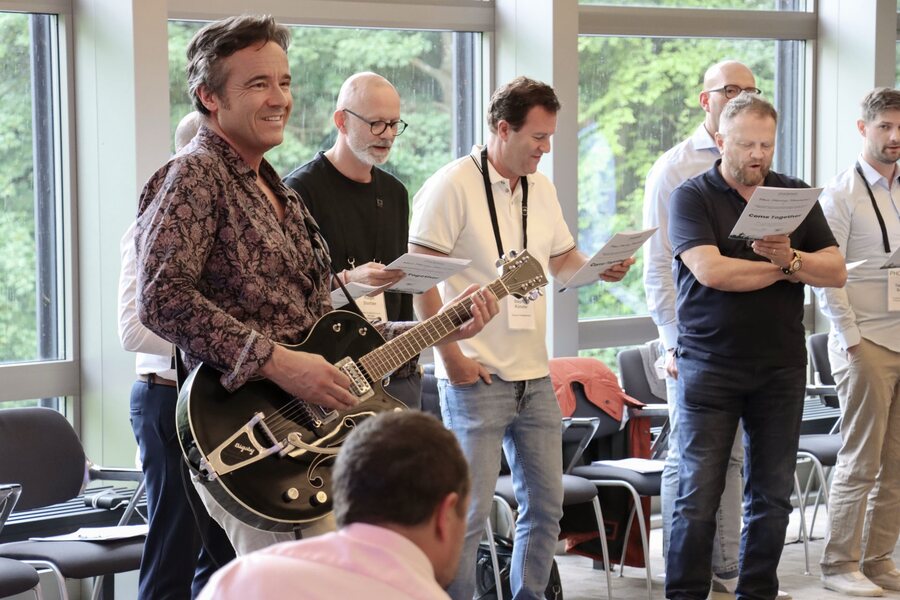
One or several days in which your team works on its own communication: switching roles, playing through difficult situations, wrestling with it together — or singing!
Out of the office. You come back with something that changes everyday work.